

FIX PAIN IN YOUR TEMPLES - WITH 4 EFFECTIVE SELF TREATMENT IDEAS
Temporal headaches can be a bothersome type of headache that occurs on the side of the head above the ears. They are often caused by irritation, inflammation, or trigger points in the temporal region, which houses important structures like the temporal bone, temporalis muscle, nerves, and blood vessels. In this blog, we will first go through some simple, easy-to-administer self treatment techniques, then go through the 3 most common causes of temporal headaches.
If you’re seeking natural ways to alleviate temporal headaches without relying on medications, Physiotherapist Mike Wong from Eastwest Physiotherapy will explore four techniques he recommends for immediate and natural relief.
4 Self Treatment Techniques
Technique 1: Self Trigger Point Release on the Temporalis Muscle


The temporalis muscle plays a role in temporal headaches. To relieve the pain, locate this muscle by placing your fingers on the area above your ears and biting down to feel the contraction. Once identified, apply gentle pressure to the tender area using your fingers or a massage ball for 30-60 seconds. Repeat this process, focusing on other tender areas. Remember to stretch the muscle afterward by applying pressure and opening your jaw wide for 10-15 seconds. Always apply gentle pressure and stop if you experience any discomfort or pain.
Technique 2: Acupressure Point Taiyang (Great Sun)

Taiyang, also known as the great Sun, is an acupressure point that can provide relief for temporal headaches. Locate it by finding the depression halfway between your eyebrow and the edge of your eye, approximately an inch toward the ear. Use your index and middle fingers to gently press on the area while taking deep breaths. Try the box breathing method, inhaling for 4 seconds, holding for 4 seconds, and exhaling through pursed lips for 4 seconds. Repeat this process as needed throughout the day for headache relief. This point can also help with other issues like eye problems, facial paralysis, and toothaches.
Technique 3: Acupressure Point LI4 (Union Valley)

Technique 4: Moist Heat Application to the Temporalis Muscle
Applying moist heat to the temporalis muscle can relax the muscle and improve blood circulation, easing tension and reducing temporal headaches. Use a warm towel or heating pad on the side of your head where the muscle is located for approximately 5 minutes. Assess your headache and continue applying heat for another 5-10 minutes or as needed for relief. Remember to use moist heat to ensure better muscle penetration and avoid excessive heat or prolonged application.
Incorporating these four techniques into your daily routine can provide natural relief for temporal headaches. However, if the headaches persist, it is advisable to consult a medical professional to address any underlying issues. Additionally, incorporating stretching exercises and maintaining proper neck and shoulder posture can help prevent headaches.
For helpful videos demonstrating these exercises, visit the provided link.
Safe Neck Exercises – https://youtu.be/iiqYQAnYUeY
Unlock Neck Pain with 3 Acupressure Points – https://youtu.be/4KF5ytAPUW4
What Are The Most Common Causes of Temporal Headaches?
01. Tension headaches
These headaches are caused by tight muscles in the head and neck that can refer pain to the sides of the head. These types of headaches are often coupled with poor posture and stress. Pictured below are 3 muscle groups that can refer pain to the temporal region. They are the upper trapezius, suboccipitals, and splenius cervicis muscles. If you massage these muscles, it can further improve your temporal headache.

02. Migraines
These intense headaches can be one-sided or two-sided, and can be felt in the temporal area. A migraine is not ‘just a headache’, it is considered a neurological event. It is often caused by a trigger (e.g. caffeine, citrus, chocolate, stress, changes in weather) that stimulates abnormal nerve and blood vessel activity in the brain resulting in a ‘cortical spreading depression’.
In simple terms, it is an intense increase in nerve activity, followed by a sudden drop in nerve activity. This abnormal neurological event leads to intense pain in the head, sensitivity to sound, light, and smells. A migraine often is a message from your nervous system telling you that it is overloaded.
If your temporal headache is caused by a migraine, massaging the temporalis muscle may be too aggravating. In this case, using acupressure points away from the head and neck region can be more helpful to calm the nerves.
Watch this short video and try these 2 acupressure points to help relieve your temporal headache from a migraine:
03. TMJ (Temporomandibular joint) Dysfunction
TMJ dysfunction can cause temporal headaches in 2 ways:
- Muscle trigger points
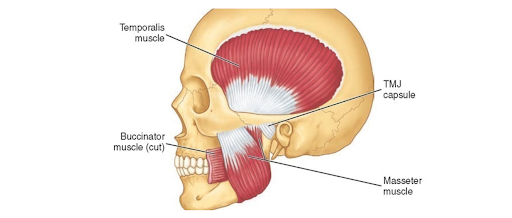
The TMJ moves using 4 main muscles (temporalis, masseter, internal and external pterygoid muscles). When these muscles are overworked from chewing, clenching, or grinding, tension and trigger points can form. The two muscles that can refer pain to the sides of the head are the masseter and temporalis muscles.
- Joint inflammation and nerve irritation
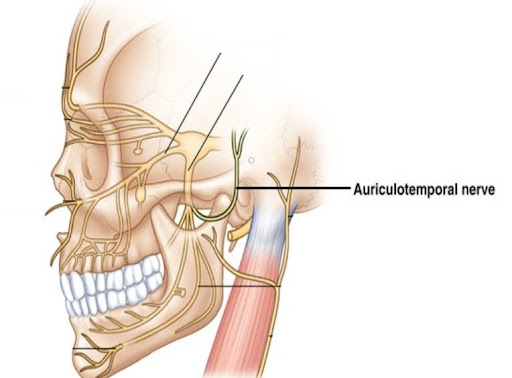
Often TMJ dysfunction involves clicking, joint compression, and inflammation at the joint. This inflammation can irritate nerves close to the joint, more specifically, the auriculotemporal nerve. This nerve supplies the skin of the temples, earlobes, ear canal, and the TMJ itself, causing pain.
Temporal headaches can occur due to different causes, each due to a different reason. The 4 treatment techniques mentioned at the beginning of the article can help address your pain at home. Knowing the underlying issue causing the pain can help you find additional help to address your temporal headache, to better target your issue.
Feel free to ask any questions in the comments section.
Wishing you a headache-free day,
From Your Burnaby Physiotherapists at EastWest Physiotherapy