

If you have an ankle injury and feel pain on the outside of the ankle, you may have sustained a sinus tarsi injury. You may not even have rolled your ankle but you feel a pinch and sharpness from time to time on the outer part of your ankle. This is often worsened by walking on uneven ground during hiking and walking barefoot in the sand. This can lead to chronic and persistent ankle pain and instability.
At EastWest Physiotherapy Burnaby clinic, we see patients with this problem after repeated ankle sprains and suboptimal rehabilitation. The good news is that with the right treatment and exercises, most people recover well.
In this article, we will cover:
- What is the sinus tarsi
- Common symptoms of sinus tarsi syndrome
- How physiotherapy can help recovery
- 3 Exercises to improve ankle stability
One acupressure point that may help reduce pain
What Is the Sinus Tarsi?
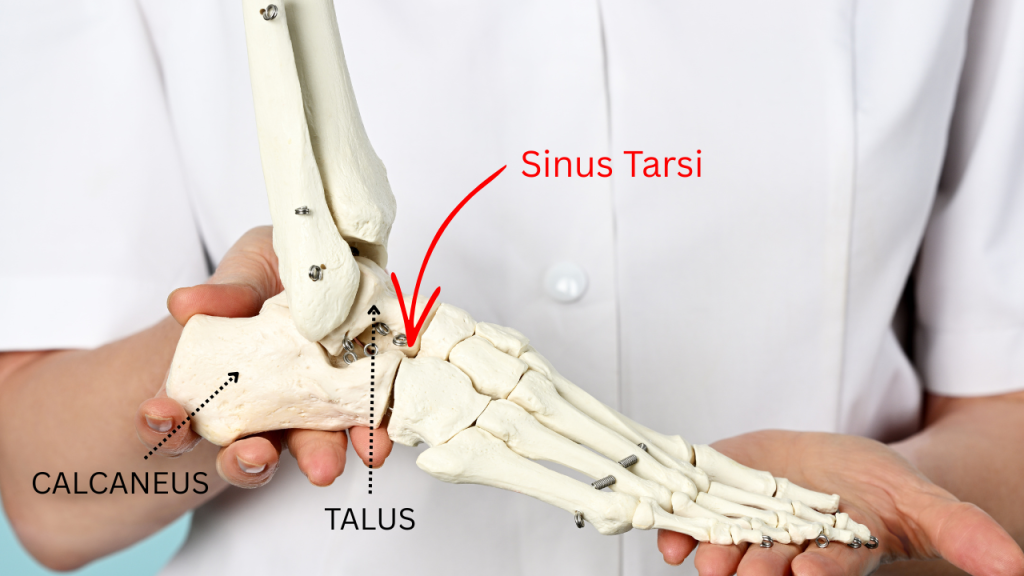
The sinus tarsi is a small tunnel-like space on the outside part of the ankle, between two bones:
- The talus (ankle bone attached to the lower leg bone (tibia)
- The calcaneus (heel bone)
There are some important structures within this small tunnel that contains:
- Ligaments that stabilize the foot
- Nerves that help with balance and joint awareness
- Blood vessels
This area of the ankle controls the side to side movement of the foot, so activities that involve foot stability and balance like walking and running can stress that area. When this area gets injured either with trauma and repetitive stress, this condition is called sinus tarsi syndrome.
Common Causes of Sinus Tarsi Injury

Recurrent ankle sprains
Patients may develop sinus tarsi pain after multiple lateral ankle sprains. The ligaments that support the ankle joint become weak and the subtalar joint becomes unstable, leading to repeated stress in the joint.
Flat feet/Overpronated foot
As the foot collapses inward with weight bearing and activity, it can place extra stress on the sinus tarsi.
Sports injuries
Activities that require a lot of ankle stability such as soccer, basketball, and trail running can increase stress on the subtalar joint. Repeated stress in those areas can lead to instability and pain.
Scar Tissue and Fibrosis
With repeated stress and irritation to the ankle, scar tissue can form in the sinus tarsi, which reduces the space and compresses the nerves.
Symptoms of Sinus Tarsi Syndrome
Symptoms appear on the outer side of the ankle.
Some common signs include:
- Pain in front of the outer ankle bone
- Tenderness when pressing the area
- Pain when walking on uneven surfaces
- Feeling like the ankle is unstable or giving way
- Difficulty standing on one leg
If these symptoms persist for weeks after an ankle injury, it is important to get a proper assessment from a Burnaby physiotherapist.
How Physiotherapy Helps Sinus Tarsi Injuries
At EastWest Physiotherapy in Burnaby, treatment focuses on restoring stability, decreasing inflammation/swelling, and reducing stress on the subtalar joint.
Physiotherapy techniques may include:
- Manual therapy to improve ankle mobility
- Strengthening exercises for the foot and ankle
- Balance training to improve joint stability
- Assessing and correcting gait patterns
- Acupuncture to help reduce pain, improve circulation and function
- Electrotherapy to decrease pain and break down scar tissue/adhesion
- Super Inductive System to optimize cellular healing and relieve pain
- Taping and Bracing as appropriate
Strengthening the right muscles can reduce pressure on the sinus tarsi and improve recovery.
Here are three evidence-based exercises we often recommend to strengthen the muscles of the foot, reduce pressure on the sinus tarsi to help speed up the recovery process. You may easily search for these video exercises online.
Exercise 1: Y-Balance Exercise (Star Excursion Balance Test)
- Balance first
Stay steady on your standing leg. Keep your foot flat and knee aligned over your toes. - Reach with the other leg
Slowly reach your free leg as far as you can in one direction:- Tap the floor lightly with your toes
- Do NOT put full weight down
- Return with control
Bring your leg back to the starting position without losing balance. - Repeat all directions
Perform in this order:- Forward
- Back & inward
- Back & outward
Reps & Sets
- 3–5 reaches per direction
- 2–3 sets per leg
- Do both sides
Exercise 2: Resistance Band Ankle Strengthening (All 4 directions)
Setup
- Sit on the floor or a chair
- Keep your leg straight or slightly bent
- Use a resistance band looped around your foot
- Anchor the other end to something stable (or hold it)
How to Perform (4 Directions)
1. Dorsiflexion (Pull foot up)
- Anchor band in front of you
- Pull your foot up toward your shin
- Slowly return
2. Plantarflexion (Push foot down)
- Hold band in your hands
- Push your foot down like pressing a gas pedal
- Slowly return
3. Eversion (Turn foot outward)
- Anchor band on the inside
- Turn your foot outward against the band
- You should feel the outside ankle working
4. Inversion (Turn foot inward)
- Anchor band on the outside
- Turn your foot inward against resistance
- Control the return
Reps & Sets
- 10 reps per direction
- 3 sets each
- Do both sides if needed
Exercise 3: Single Leg Balance (Do this without shoes)
Balance exercises help restore the proprioception of the ankle. This is important because the sinus tarsi contains many nerve endings that help with joint awareness.
Setup
- Stand on the affected leg.
- Keep your foot arch gently lifted.
- Try to maintain balance.
Progressions
To make the exercise more challenging:
- Close your eyes
- Stand on a cushion or foam pad
- Toss a ball with a partner
Reps and Sets
- Hold for 30 seconds
- Repeat 3-5 times
Acupressure Point for Sinus Tarsi Pain
In addition to strengthening exercises, some patients find relief using acupressure.
An important acupressure point that you can use for Sinus Tarsi Pain is GB40 (Gallbladder 40).
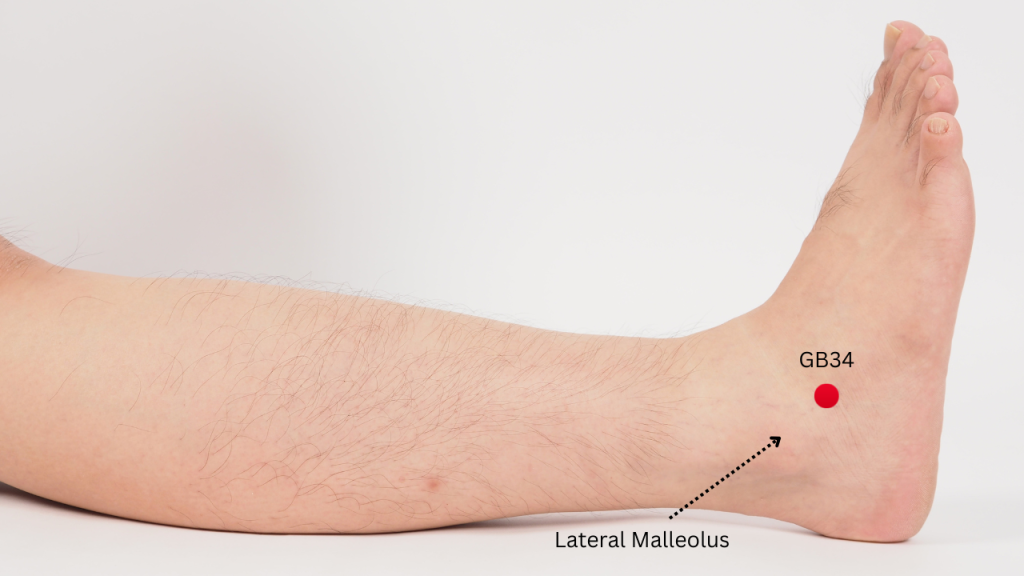
Location
GB40 is located:
- In front of the outer ankle bone
- In the small depression just anterior to the lateral malleolus
How to apply pressure
- Use your thumb to press gently into the point.
- Apply steady pressure for 30–60 seconds.
- Repeat 2–3 times per day.
This point is commonly used in Traditional Chinese medicine to help relieve:
- Lateral ankle pain
- Foot stiffness
- Joint inflammation
At EastWest Physiotherapy Burnaby, we have the ability to use modern rehabilitation with traditional techniques such as acupressure or acupuncture to support your recovery.
When to See a Physiotherapist
If ankle pain continues for more than two to three weeks, it is important to get a professional assessment. Early treatment prevents complications and repetitive reaggravation to the injured area, leading to chronic pain and instability.
Consider seeing our Physiotherapists if you experience:
- Persistent ankle pain after a sprain
- Difficulty walking on uneven ground
- Repeated ankle instability
- Pain when pressing the outer ankle
Burnaby Physiotherapy for Sinus Tarsi Injuries
At EastWest Physiotherapy & Massage Therapy in Burnaby, our physiotherapists take a comprehensive approach to ankle injuries. We combine modern rehabilitation techniques with evidence-based care to help patients recover safely and return to their activities.
Your treatment may include:
- Detailed injury assessment
- Personalized exercise programs
- Manual therapy and joint mobilization
- Balance and stability training
- Education to prevent future ankle injuries
With the right care, most sinus tarsi injuries improve significantly.
If you are experiencing ankle pain or instability, our Burnaby physiotherapy team is here to help. Contact EastWest Physiotherapy today to start your recovery.